
Introduction
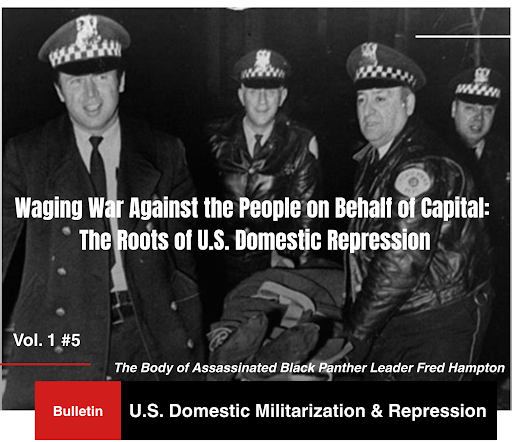
Waging War Against the People on Behalf of Capital: The Roots of U.S. Domestic Repression
The U.S. State Is a “State of War” — George Jackson, Blood in My Eye
On July 16, 2026, U.S. Secretary of State Marco Rubio convened a gathering of United States government officials, congressional representatives, and governmental officials from 65 nations at the State Department. Informally called the “Antifa summit,” the topic that brought everyone together was the supposed resurgence of “left” political terrorism.
Secretary Rubio declared that U.S. counterterrorism doctrine has “had a blind spot—a blind spot when it comes to extremist violence from the political left. Even today, the very idea that far-left terrorism could be a serious threat is treated as a right-wing fever dream, or worse, as a dangerous fascist conspiracy.”
He added: “Far-left political terrorism is not a recent-day, modern novelty. It is not a fiction manufactured by conservative politicians. For most of the modern era, it was, in fact, the dominant form of political violence.”
Of course, no evidence is offered to back up the assertion that so-called left-wing violence could claim more victims than two global wars precipitated by rightist colonialist nations—from the First Imperialist War to the right-wing Nazis of the Second Imperialist War—the millions murdered by colonial governments in their frantic and delusional attempts to reassert colonial control after the end of the Second World War, which also included U.S. misadventures in Korea and Vietnam, and the so-called “War on Terror” unleashed by the United States when the countervailing force of the Soviet Union disappeared.
But in a period of normalized irrationality, where evidence to substantiate intellectual arguments is unnecessary and the historical experience of just the twentieth century negates Rubio’s assertions, it is power that imposes its definition of truth.
The objective of Marco Rubio and U.S. officials such as Stephen Miller is to take another political and institutional step toward consolidating fascism—while criminalizing opposition to fascism! What is “antifa” besides an abbreviation for social forces opposing fascism?
As slick as this move was to intimidate and criminalize opposition to fascism at this gathering, the real history of the United States demonstrates that the fallback position to fascism as a response to capitalist crisis and/or to preempt political opposition from the left is nothing new, especially for African/Black organizations and our movements for social change and basic survival.
Our current bulletin will resurrect and contextualize that history and the specific expressions of institutional oppression emanating from the U.S. national security state. The Bulletin’s feature article, “Twentieth Century Red Scares in the United States,” by Dr. Charrise Burden-Stelly, contextualizes the current assault on human rights while also reminding readers that the declaration of war on the left in general still inevitably means a concentrated focus on revolutionary African/Black organizations. There is nothing new in that focus. It ultimately means that this particular iteration of repression represents the historical continuity of efforts to criminalize and destroy African radical organizations and left opposition in general.
And while the specific conditions of consolidating fascism in the United States are unique to this moment of deep institutional weakness and declining legitimacy, the significance of National Security Presidential Memorandum 7 (NSPM-7), “Countering Domestic Terrorism and Organized Political Violence, unveiled last September, is not a reflection that the United States suddenly rediscovered political repression. Rather, its significance lies in the reconstitution of an older repertoire of political repression through the institutional technologies of the post-9/11 security state, mobilized to confront what the state increasingly represents as an existential threat posed by opposition from the left.
COINTELPRO sought to disrupt organizations capable of producing independent Black political power; the post-9/11 state developed unprecedented capacities for network surveillance, financial intelligence, and preemptive intervention; NSPM-7 potentially brings these two histories together around an expanded conception of left political extremism. For Black radical forces, the danger is therefore not merely that particular organizations may be labeled “terrorist.” The deeper danger is that independent Black political organization, Black internationalism, and anti-imperialist politics are increasingly being interpreted through a national-security framework designed to disrupt the development of autonomous political power, inviting murderous repression from the state.
From the Palmer Raids, McCarthyism, and COINTELPRO to post-9/11 counterterrorism, NSPM-7, and the 2026 State Department anti-left initiative, left opposition today is being framed as an international counterterrorism problem.
That is an ominous development, but one consistent with the fascist agenda. The more than two hundred Joint Terrorism Task Forces across the United States have been unleashed against anti-fascist opposition. However, what we have are the people and a determination to resist. This is where the People(s)-Centered Human Rights framework has strategic value: the defense of political opposition becomes inseparable from the defense of collective political agency and peoples’ right to organize themselves as political subjects.
This is a threat to fascism, but we have no other choice. At this historical moment, this must be the task, the responsibility, and the objective of anti-fascist opposition. The fate of the world demands no less.
Ajamu Baraka
Director, North-South Project for People(s)-Centered Human Rights
Featured Articles
Twentieth Century Red Scares in the United States
Charisse Burden-Stelly
Red Scares are central to the “countersubversive political tradition” in which United States governance is rooted. This tradition extends back to the set of repressive laws known as the Alien and Sedition Acts of the 1790s, which became a frequent point of comparison for subsequent antiradical legislation like the Alien Registration Act of 1940 (Smith Act) and the Internal Security Act of 1950 (McCarran Act). Referencing the intense period of anticommunism following World War II, the Black Communist Claude Lightfoot argued, “The nation had not experienced a period like this since the days of the Alien and Sedition Laws.” Similarly, as he was being interrogated before the House Committee on Un-American Activities (HUAC) for his communist affiliations, Paul Robeson chided, “You are like the Alien Sedition Act, and Jefferson could be sitting here, and Frederick Douglass could be sitting here and Eugene Debs could be here.” In naming Jefferson, Douglass, and Debs, Robeson illuminated how the countersubversive political tradition targeted not only communists, but any dissidents that could be construed as such. Through the countersubversive political tradition, the U.S. state produces and perpetuates a fear of “alien ideologies” and the “foreign influences” purportedly aimed at upending the ideals and organization of the republic. Historically, this hostility has been linked to the idea of internal racial, ethnic, and religious enemies who were allied with, sympathetic to, or could be easily duped by hostile external forces.1
Red Scares, which became almost exclusively articulated through anticommunism after the Bolshevik Revolution of 1917, encompass “the criminalization and condemnation of anticapitalist ideas, politics, and/or practices through discourses of radical takeover, infiltration, and disruption of the American way of life to maintain a society dominated by a capitalist elite and organized along race and class lines.” Red Scares have been most prominently articulated through the specter of the communist/Bolshevist and the fellow-traveler, though all types of radicals, including anarchists, socialist, communists, labor militants, and Black liberationists become interchangeable as “Reds” against who the U.S. government justifies waging “unflinching” war. These concentrated periods of political repression foment an atmosphere of fear, hatred, and obsession about radical organizing by construing it as dangerous to the nation and driven by conspirators and agitators. As such, ordinary speech and action otherwise protected by the constitution are transformed into criminal activity and/or enemy machinations. For example, social and economic reforms are mischaracterized as a slippery slope to communist takeover. Leftwing organization, discipline, and international solidarity are misconstrued as foreign-controlled conspiracy. Any form of politics other than liberal capitalist democracy is accused of being authoritarian. A rejection of Christianity is considered immoral and un-American godlessness. In a general sense, counterhegemonic ideas, writings, organizing, and protest are treated as criminal conspiracy and domestic terrorism.2
The recent publication of two government documents, the “National Security Presidential Memorandum 7: Countering Domestic Terrorism and Organized Political Violence” (NSPM-7), issued on September 25, 2025, and “Cuba: The Capital of 21st Century Communism” (Cuba report), released on July 20, 2026, attest to our current Red Scare moment. The NSPM-7 uses anti-fascist organizing and “Antifa” as the jumping-off point to characterize as domestic terrorists those who oppose racism, the abrogation of the rights of undocumented, queer, and trans folks, the unleashing of state agencies to indiscriminately brutalize civilians, and the transformation of the United States into a Christian nationalist kleptocracy. Such beliefs are construed as the “violent conduct” of “domestic terrorists,” connected through the “common threads” of “anti-Americanism, anticapitalism, and anti-Christianity,” who are waging “violent assault against democratic institutions, constitutional rights, and fundamental American liberties.” The National Joint Terrorism Task Force is thus empowered by NSPM-7 to “coordinate and supervise a comprehensive national strategy to investigate, prosecute, and disrupt entities and individuals engaged in acts of political violence and intimidation,” with a particular focus on institutional and individual funders, organization members, and employees. This framework was applied in the prosecution of the “Prairieland 9” and the federal indictment of the “Michigan 8” earlier this year.
The Cuba report builds on the antiradicalism of NSPM-7. It paints a long history of Cuba anti-American action; ties Cuba to U.S. “enemies from without,” not least Iran, Venezuela, Russia, and China; and presents the Cuban government as the puppet master of past and present “enemies from within.” The latter includes Black Power and Third World activism, Antifa and anti-ICE militancy, and the student encampments and George Floyd uprisings. Additionally, the report links the external and internal threats together to intensify the claims that Cuba is undermining U.S. national security. This anti-Cuba screed aims to legitimate the genocidal oil blockade and a possible ground invasion, while discrediting internal movements and organizations by claiming they are foreign inspired (e.g., the Venceremos Brigade), fellow-traveler organizations (e.g., Black Alliance for Peace), or catalysts to spread extremism into legitimate politics (e.g., Democratic Socialists of America). Moreover, by linking organizations, individuals, and movements to Cuba, the State Department seeks to criminalize constitutionally protected forms of radical fightback and to construe higher education as a hotbed of radical subversion.
The current attack on radicals and progressives, spanning both the Biden and Trump regimes, is the latest upsurge in a long history of Red Scare repression. While the period between 1919-1920 is considered the “first Red Scare,” between 1873-1903, several Red Scares targeted labor and anarchists. They were spurred by frequent economic depression and uncertainty, worker militancy and strikes, and elite fear about the Paris Commune and its aftereffects. At this time, “communism” became a catchall term for sundry unsavory and “dangerous” elements. This was also the period in which the fear of communist revolution and foreign radicals crystallized.3 In 1901, for example, after the assassination of President William McKiney by an accused anarchist, there was widespread “passage of federal and state laws that for the first time since the Alien and Sedition laws penalized persons solely on the basis of opinions, affiliations and advocacy, rather than on the commission of what would normally be considered a crime.”4
A host of state-level anti-syndicalist, anti-Anarchist, and antiradical laws became codified in the Espionage Act of 1917 and the Sedition Act of 1918, passed during World War I. It was under the former that hundreds of Wobblies (members of the Industrial Workers of the World) were convicted, effectively neutralizing the organization.5 Between 1919-1923, “innumerable repressive statutes, regulations and ordinances which deal[t] more harshly than the federal government with political dissent and democratic rights” cropped up after the failure to pass national anti- syndicalism. One reason a federal bill did not come into fruition was because some senators feared they would give the US government jurisdiction over the crime of lynching. State-level laws variously sought to guard against the overthrow by force, violence, injury to person or property, or general strike, of the government; disloyalty or belief in anarchy or other dangerous political doctrines; defiance of the law in relation to the disruption of organized government; inciting people to disorder or breaches of law; and the display of any symbol that supported or promoted Bolshevism, anarchy, or radical socialism. State-level antiradical campaigns immediately following World War I were buttressed by widespread sentiment that the labor unrest resulting from postwar economic conditions was in fact caused by Bolshevik agitation. This misconception helped to hasten the shift from Germans to communists, Bolsheviks, and the Soviet Union as the paramount enemies of the United States.6
The 1919-1920 Red Scare, which coincided with the “Red Summer” pogroms against Black people, was characterized by the “Palmer raids” and mass deportations of primarily Eastern European anarchists and communists. In 1920, more than 10,000 workers across seventy cities, most of whom were trade unionists, were arrested and thrown in federal prison based on orders from Attorney General Mitchell Palmer and J. Edgar Hoover. The purpose of the raids was to round up as many “aliens” for deportation based on their political beliefs. While the overwhelming majority were freed because they were citizens or acquitted of wrongdoing, they were beaten up, maimed, denied due process, and otherwise brutalized. This Red Scare also helped to weaken labor, strengthen big business through pushing the open shop, and frightened people against militant action.7
Less commonly acknowledged is the Red Scare of 1939-1940 in response to a number of international developments, most significantly the Molotov- Ribbentrop Pact between the Soviet Union and Germany. Nativist and anti-labor in scope, this period of repression ostensibly targeted, fascists, Nazis, and communists, but in reality, it largely targeted the latter. A few months before the December 1941 attack on Pearl Harbor, Attorney General Francis Biddle used stipulations of the Act to Prevent Pernicious Political Activities (the Hatch Act) passed in 1939, to create a list outlining which organizations were deemed subversive enough to warrant the detainment and possible deportation of aliens affiliated with them. Nearly in tandem, the Department of Justice secretly drafted a list detailing groups thought to include predominately “alien radicals” that could be construed as anarchistic, subversive, or seditious. The list would determine who would be eligible for trial by the Alien Enemy Hearings Board. Taken together, these lists were virtually all-encompassing, with the DOJ’s list targeting the general civilian population while Biddle’s list was used to evaluate federal employees.8 This period also saw the passage of the Smith Act and the Anti-Propaganda Act (Voorhis Act) in 1940, as well as the establishment of HUAC as a special investigative committee, and later, a permanent committee.
The era of McCarthyism, formally spanning 1951-1954 with the election and subsequent downfall of Wisconsin Senator Joseph R. McCarthy, but functionally periodized as 1947-1957, is probably the most well-known Red Scare. This period is bookended by the passage of the Taft-Hartley Act and the creation of the Loyalty Security Act under Executive Order 9835 in 1947 and the 1957 Watts v. United States and Yates v. United States Supreme Court cases that overturned convictions of those who refused to answer questions before HUAC and of CPUSA leaders prosecuted under the Smith Act, respectively. The era in between was one of anticommunist hysteria, witch hunts, fear, and abrogation of civil rights and liberties. As one scholar explains, “properly used, the term McCarthyism means accusing people without evidence, exposing and causing them harm without regard for the law or for common decency.”9 Both parties and all three branches of the federal government, as well as state and local governments, participated in the full court assault on all forms of militancy that could be construed as communist, from labor militancy to civil rights insurgencies. During this period, top leaders in the CPUSA were indicted, prosecuted, jailed, deported, and/or forced underground and Hollywood was investigated for supposed communist infiltration. Some of the most repressive legislation of the century, including the Internal Security Act of 1950 (McCarran Act), the Immigration and Nationality Act of 1952 (McCarran-Walter Act), and the Communist
Control Act (1954), was passed. As well, the Subversive Activities Control Board (SACB) and Senate Internal Security Subcommittee (SISS) were established. Through anticommunist lawfare, big business intimidation, vigilante violence, and widespread fearmongering, countless lives were ruined, jobs were lost, organizations were destroyed, families were fragmented, and movements were hampered.10
The explosion of the Counterintelligence Program (COINTELPRO) in the 1960s is undoubtedly the most notorious epoch of repression. The program was a means for the FBI to address “the threats from militants of the ‘New Left’ as it had those from the Communists in the 1950s.” It employed “traditional investigative techniques and counterintelligence” to “counteract domestic terrorism and conduct investigations of individuals and organizations who threatened terroristic violence.” These “techniques and counterintelligence” included illegal wiretapping, bugging, break-ins, frame-ups, and informant infiltration, harassment, and disruption campaigns.11 All-in-all, the FBI launched at least 2,218 individual COINTELPRO actions against groups and individuals—primarily radicals, and a disproportionate number Black—between 1957 and 1971.12 Though it is an outgrowth of the efforts of the FBI to decimate the CPUSA, COINTELPRO is not commonly understood as a Red Scare offensive that was given new life through the assault on Black and Third World liberation. J. Edgar Hoover claimed, “communists and subversives and extremists strive ceaselessly to precipitate racial trouble and to take advantage of racial discord in this country.” It was they who “aggravated and exploited” race rebellions that exploded across the United States.13
It should be emphasized here that, especially in the second half of the 20th century, Third World countries and peoples were as much a target of Red Scares as communists. As Abdulrahman Babu argued,
Although American imperialism was supposedly fighting communism throughout this period you’d find that American presidents—every American President—had to have a Third-World leader as a villain. They never fought the Russians. Truman had Kim 11 Sung, the North Korean leader, as the villain and he mobilized American forces and international forces to fight this villain. Eisenhower had Mao Tse Tung as the villain, not the Russians but Mao Tse Tung. Kennedy had Castro as the villain, not the Russians but Castro. Then came Johnson—he had Ho Chi Minh as the villain, not the Russians but Ho Chi Minh as the villain. Then came Nixon. His villain was Sihanouk of Cambodia. He had to destroy that country in order to prove Sihanouk was his villain. Then came Carter. He chose Khomeini as villain. He was followed by Reagan, and he chose Ghaddafi as his villain. And now we have Bush with Saddam Hussein as his villain.
This is not accidental, explained Babu, but rather the result of the fact that the “United States contains a large population from Third World countries in its own borders, more than any other country in the Western World.” And, there is a reciprocal relationship between the poor treatment of racialized/colonized peoples in the US and the negative foreign policy toward the Global South that is concealed through anticommunist discourse.14 Thus, U.S. government officials linked the “communist” threat abroad—especially in the Third World—to the latest dimension of the communist threat at home: Black political violence in the form of guerilla tactics, clashes with authority, and ferocious challenges to racial and economic hierarchy. By 1972, nearly 500 local “Red Squads” understood themselves as the most effective political force in blocking “radicalism, student demonstrations, and black power” and were gathering “political intelligence” about these dissident groups a.15 Thus, the discourse of close links between “foreign communists and domestic dissidents” continued to animate the rollback of civil liberties.16
The Red Scare of the 1960s and 1970s construed urban and student rebellions, militant Black organizations, struggles against the Vietnam War and draft, and international solidarity as a menace to the prevailing order. The result was “a calculated campaign by high-ranking officials in the executive branch and by Congress to intimidate and repress dissident activity.”17 For example, for a brief period in 1968, in the midst of urban insurrections that engulfed the nation after the April 4 assassination of Dr. Martin Luther King, Jr., the notorious SACB was revived through a bicameral bill that “gave the SACB the power to simply list by fiat groups found to be communist-action or communist-front organizations.” As well, HUAC issued a report urging the construction of concentration camps authorized by the McCarran Act to temporarily imprison warring guerillas— i.e., radical and Black groups that were “seriously considering the possibility of instituting armed insurrection” and “planning ‘guerilla-type operations against the government.’”18 Moreover, in the 1970 hearings on “Assaults on Law Enforcement Officers” conducted by the SISS, there were several references to the rebellions being “Communist inspired,” the Black Panther Party and other radical Black organizations being “Uncle Toms” to white Communists, Communist agitators infiltrating racial disturbances, and the identification of Black urban rebels with “the third world type communist effort.” Authorities directly linked these imagined communist machinations to ostensible Black plots to foment revolution in the United States. Even those who testified that Black rebellions were not “solely” a matter of communism and who suggested racial unrest might stem from issues other than “communistic motivation, inspiration, guidance, control” or manipulation, nonetheless took pains not to “minimize the extent to which Communists would like to bring about the downfall of” the United States.19
The current Red Scare reality is a continuation of these earlier periods of anticommunist repression. For example, the Cuba report constructs the Soviet Union as the primary enemy of the “Old Left” that was largely destroyed by McCarthyism, and Cuba as the “New Left” foe whose influence takes off during the 1960s and continues through to today. It reads, “Whereas the old Soviet left had been built around the party, labor unions, and Marxist theories of economic class struggle, the New Left was animated by Black Power, radical feminism, Third World liberation, and—above all else—the radical rejection of Western culture, history and identity in all its forms.”20 Targeting the “New Left” allows the state department to conflate communism, race and gender radicalism, and anticolonial struggles as indistinguishable enemies. Likewise, referencing McCarthyism’s defeat of the “Old Left” legitimates the use of similar repression to crush current insurgencies attributed to their “New Left” predecessor. While Red Scares are extraordinarily disruptive, destructive, and dangerous, it is equally important to acknowledge their inability to completely crush militant fightback and organized action. The people who are steadfast in their struggle for people(s)-centered human rights, the end of capitalist imperialism and (neo-)colonialism, and an ecologically sustainable future cannot be totally defeated. Red Scare repression and its catastrophic effects on communities, organizations, and individuals must be taken seriously, but should not sow doubt about the power and future victory of the people. In the final analysis, it is the masses organized against capitalist imperialism that will deal the deathblow to the Epstein class heirs of J. Edgar Hoover and Joseph McCarthy.
- Charisse Burden-Stelly, Black Scare/Red Scare: Theorizing Capitalist Racism in the United States (Chicago: University of Chicago Press, 2023), 206.
- Ibid., 5-6.
3 Goldstein, 23-60
4 Ibid., 63.
- Burden-Stelly, 193.
- Ibid., 139-141.
- Richard O. Boyer and Herbert Morais, Labor’s Untold Story (New York: Cameron Associates, 1955), 212-215.
8 Burden-Stelly, 167.
- Robbie Lieberman, Ed., History in Dispute: The Red Scare After 1945 (Gale: Farmington Hills, 2005), xviii.
- Ibid., xviii-xx.
- Michael Newton, The FBI Encyclopedia (Jefferson, NC: McFarland & Company, Inc., 2003), 68.
- Ibid., 72.
- Robert Justin Goldstein, Political Repression in Modern America: From 1870-1976 (Urbana: University of Illinois Press, 2016 [2001]), 438.
- Abdulrahman Babu, “Speech at the International Conference on Malcolm X: Radical Tradition and a Legacy of Struggle, November 1-4, 1990,” in The Future that Works: Selected Writings of AM Babu eds. Salma Babu and Amrit Wilson (Trenton: Africa World Press, 2002), 85.
- Robert Justin Goldstein, Political Repression in Modern America: From 1870-1976 (Urbana: University of Illinois Press, 2016 [2001]), 504-509.
- Ibid., 436-437.
- Ibid., 432-435, 435.
- Ibid., 441.
- Subcommittee to Investigate the Administration of the Internal Security Act and Other Security Laws, Assaults on Law Enforcement Officers, Part 4 (Washington: US Government Printing Office, 1970).
- “Cuba: The Capital of 21st Century Communism,” 14.
The FBI Has Deputized Local Cops as Federal Agents. Communities Are Resisting
Organizers are fighting the FBI’s Joint Terrorism Task Forces, gaining momentum from the broader anti-ICE movement.
July 11, 2026
As the Trump administration widens its crackdown on immigrant communities and progressive activists, federal task forces are playing an important behind-the-scenes role. Organizers warn that institutions like the FBI’s Joint Terrorism Task Forces (JTTFs) are targeting vulnerable communities and sharing the kind of information that facilitates Immigration and Customs Enforcement (ICE) raids. But some say the current political climate also presents opportunities as appetites grow for local and state agencies to cut ties with the federal task forces endangering their communities.
“We have an opportunity for more allies because more people are upset, more people feel that they are impacted, more people see their neighbor being dragged away, and they don’t like it, and so the body of people that feel like something should be done is larger,” Tracy Rosenberg, advocacy director at Oakland Privacy, told Truthout. “We should take advantage of that to protect people who have been vulnerable this whole time.”
JTTFs deputize state or local police officers as federal agents, meaning a local cop who is contracted to work with a JTTF has the same policing powers as an FBI agent, and the Department of Justice can shield them from litigation and local oversight. Often, those police officers no longer have to follow their own departmental regulations on the use of force or body-worn cameras. The arrangements also come with federal dollars and gear.
“The laws that apply to [local and state law enforcement agents in JTTFs] are the federal standards,” Sumayyah Waheed, senior policy counsel at Muslim Advocates, explained to Truthout. That means that “if there are more protective standards around privacy or around sanctuary that operate in a city or locality, then typically the agreements that underpin these task forces make the federal law the standard — sanctuary becomes kind of obsolete, and additional privacy protections don’t apply.”
The Trump administration’s global campaign against ‘radical left terrorism’ is built on a national security memo without congressional approval
Melinda Hass
July 17, 2026
A little-noticed presidential national security directive is now the legal engine behind a wave of terrorism prosecutions against left-wing protesters. That domestic campaign now has an international dimension, one that American officials had been planning for months, culminating on July 16, 2026, when Secretary of State Marco Rubio’s Ministerial on the Resurgence of Political Terrorism drew representatives from more than 65 countries to Washington. The gathering was informally called the “Antifa summit.”
Rubio described antifa-aligned networks as sharing infrastructure across borders and accused Iran and Cuba of helping bankroll the movement, without offering evidence. The White House declared the summit the start of an “unprecedented global offensive” against what it calls “radical left terrorism.” This offensive is built on the same domestic legal architecture that has now sent American activists to prison for decades.
That architecture is National Security Presidential Memorandum/NSPM-7, issued on Sept. 25, 2025, which for the first time appeared to authorize preemptive law enforcement measures against Americans based not on whether they are planning to commit violence but for their political or ideological beliefs. Nearly a year later, that blueprint has moved from paper into practice.
The Justice Department has built task forces staffed by counterterrorism prosecutors. The FBI has set up its own NSPM-7 mission center to oversee investigations into left-wing movements, including a joint effort with the IRS to investigate nonprofit groups. The Justice Department has used this machinery to convict activists and send some of them to prison for decades.
NSPM-7 was not passed by Congress. It’s a lesser-known tool of executive power: a presidential memorandum. As an international relations scholar who has studied U.S. foreign policy decision-making and national security legislation, I recognize that presidents can take several types of executive actions without legislative involvement: executive orders, memoranda and proclamations. This structure allows the president to direct law enforcement and national security agencies, with little opportunity for congressional oversight.
Nine hours in front of a computer: 11-year-old boy waits for his turn in massive audience of migrant minors

Houston, September 12, 2026
An activist narrates how she accompanied this minor in the long wait until her appointment with an immigration judge after the cancellation of federal aid to organizations that legally represent children
Jose waited nine hours sitting in front of a computer for his virtual hearing before an immigration judge. He is 11 years old and, with him, 25 children were on the screen. He was the youngest in this massive preliminary hearing, one more tool that the Trump administration has been using since May 2026 — according to lawyers and organizations — to speed up the deportation process for more migrants at the same time. In this case, of children.
He and his father arrived at 7:30 a.m. on July to the home of an activist who assisted them to enter the federal court system on the east coast of the United States. She is the one who tells this story anonymously, changing the name of the child and without providing its location for fear of affecting immigration cases of the entire family. An immigration lawyer linked to Jose’s case verified the testimony.
“At two in the afternoon, he was like, ‘Oh, ma’am, we’ve been here for six and a half hours.’ I was kidding about it, he didn’t complain. He behaved like a true champion,” the activist recounts in a video call. By order of the judge, he was to remain visible on the screen, like the rest of the children, some of them unaccompanied minors who attended his hearing from government shelters.
In the case of José, the activist was looking for food and, at one point, when he saw him tired to rest his head on the table, he sought a pillow to lie down. On the computer, another of the children had already fallen asleep with his head lying on his right hand.
The group was divided between those with legal representation — half of the minors — and those who did not, and their cases were reviewed in that same order. His audience was the penultimate of the day, it began at four in the afternoon. It lasted 15 minutes. The judge asked if he had a lawyer. He replied no. Who accompanied him. And he said his father. He explained the process he would face, gave him indications and decided to give him a few more days to obtain legal representation and evidence to support his asylum case.
Thousands of children, sponsors arrested by ICE after tips from US child migrant agency
July 28, 2026
Aurora’s 6-year-old daughter arrived at the U.S. border alone and spent more than half a year in a child migrant shelter while her mother, who was already in the country, worked to get her out. The two were finally reunited in late March.
“We were overjoyed,” said Aurora, 24, who like others in this story spoke on the condition they be identified only by their first names. Days later, however, mother and daughter were detained by Immigration and Customs Enforcement and sent to a family detention center in Texas, records show. They are among more than 12,000 people arrested by U.S. immigration authorities following tips from the Office of Refugee Resettlement during President Donald Trump’s second term, according to internal government data reviewed exclusively by Reuters.
ORR was created in 1980 to resettle refugees fleeing war and persecution. Since the early 2000s, the agency has also been charged with housing unaccompanied migrant children arriving at the U.S.-Mexico border, like Aurora’s daughter. The care of these children has historically been walled off from immigration enforcement. A 2008 law sought to ensure they were placed in the least restrictive setting and released from detention as soon as safely possible, regardless of their sponsors’ legal status. That meant migrant families could be reunited without fear of being targeted by ICE, even if they were in the country illegally.
The Trump administration has taken a drastically different approach. Since January 2025, the data shows, ORR has shared more than 460,000 “leads” with ICE about unaccompanied children, their sponsors — usually parents or other relatives — and additional household members, leaving them vulnerable to detention and deportation.
While Reuters and others have reported on the growing cooperation between ORR and ICE, this story is the first to reveal the scale of the information shared for immigration enforcement.
Interviews with migrant families, legal advocates and current and former U.S. officials illustrate the far-reaching implications of this policy shift and its human toll.
Jen Smyers, who served as deputy director of ORR during the Biden administration, said safeguards against data sharing with ICE have been “completely reversed.”
“They are weaponizing a child welfare program for the purposes of more deportations,” she said.
In a statement to Reuters, ORR said it “plays no role in the apprehension of children,” referring questions about immigration enforcement to the Department of Homeland Security, ICE’s parent agency. In response to questions from Reuters, DHS said that during Trump’s second term “ORR has provided ICE Homeland Security Investigations with potential investigative leads,” as part of an effort to locate unaccompanied children who were placed with “unvetted sponsors,” including some with criminal records.
Insurgency and Counterinsurgency: An Interview with Dylan Rodriquez
Roberto Sirvent, BAR Book Forum Editor
November 2, 2022
Dylan Rodriguez is Professor in the Department of Media and Cultural Studies at the University of California, Riverside. His work is useful precisely because he asks us not to understand state violence as a series of exceptional abuses. His concept of “antiblack domestic war” treats policing, prisons, surveillance and other state institutions as continuous formations of counterinsurgency rather than isolated deviations from an otherwise “neutral” democratic order.
This interview from 2022 that warns of the class collaborationist tendencies of traditional liberals with what is identified as the right in defense of empire is even more relevant today:
Roberto Sirvent: You recently shared on Twitter that you’ve been thinking a lot “about the spread of liberal/progressive counterinsurgency and its effectiveness in demobilizing, domesticating, and pacifying abolitionist / liberation / anticolonial / Black radical movements.” What recent examples of this counterinsurgency do you have in mind?
Dylan Rodriguez: First, I want to explain that by “counterinsurgency,” I mean the full spectrum of pacification, isolation, and domestication strategies that extend beyond violent state repression. What I’m calling the contemporary liberal/progressive counterinsurgency is a loosely coordinated bloc that consists of large philanthropic foundations, liberal think tanks, academics, elected officials, media pundits, nonprofit organizations, celebrity activists, and social media influencers, among others. This bloc is responding to the intensified and overlapping Black liberationist, abolitionist and anti-colonial mobilizations in and beyond North America, during and prior to the summer of 2020: as police cars were once again set on fire by people refusing to tolerate normalized antiblack state terror, there were increased calls for the abolition of police, abolition of jails/detention centers/prisons, reparations, redistribution of social and privatized wealth, and repatriation of land, water, and other sacred things.
All that shit has been absolutely terrifying to the administrators, organic intellectuals, and ordinary constituents of the liberal/progressive bloc. I think there is a quiet, bottom-line coalescence between this bloc, the centrist-right and elements of the far right: they are united in the fact that they will not tolerate—much less endorse or materially support—revolutionary, Black liberationist, abolitionist, and anti-colonial mobilizations and movements that will destroy or fundamentally change the infrastructures of power and radically alter the distribution of life-sustaining resources in the United States, Canada, Brazil, the Philippines, or anywhere else.
I am not arguing that liberals, progressives, so-called centrists, conservatives, and far right protofascists are somehow “the same.” What I am saying, however, is that they recognize each other by sharing a common premise: they argue and fight with each other over the path to futurity of a resilient global Civilization fantasy that abolitionists, Black liberationists, Indigenous anti-colonialists, and others are interested in disrupting, if not completely dismantling for the sake of collective survival.
Nothing Short of Torture’: Critics Decry Abuse Affirmed by DHS Alligator Alcatraz Probe
Sep 14, 2026
“DHS needs to be dismantled and held accountable for this complete inhumanity,” said Rep. Pramila Jayapal. While US President Donald Trump publicly joked about giant reptiles devouring would-be escapees from the now-shuttered Alligator Alcatraz immigrant detention center in the Florida Everglades, a newly published report by the Department of Homeland Security’s internal watchdog confirms that the biggest dangers facing detainees at the notorious lockup were found inside its walls.
The DHS Office of Inspector General (OIG) found that staff at Alligator Alcatraz —officially called the Florida Soft-Sided Facility (FSSF)—“complied with intake and use-of-force standards but did not comply with standards related to environmental health and safety, special management units, medical care, food service, personal hygiene, and recreation.”
Affirming reports from human rights groups like Amnesty International, the OIG reported on September 11 that staff at the facility, which was operated by the state of Florida and private contractors, “confined 79 detainees in small metal enclosures—each offering about 18 square feet of floor space—for periods ranging from several minutes to nearly two hours.”
“Facility staff described the small metal enclosures as ‘calming areas’ for detainees to de-escalate and have time alone,” the report states. “Staff further maintained that detainees asked to spend time in the small metal enclosures. We found at least one instance in which the small metal enclosures may have been used as a disciplinary tool.”
While held in the cages, detainees—who reported being shackled and locked to the ground—were subjected to dangerously high temperatures and swarms of mosquitoes. Amnesty described the use of the cages as a form of torture. “Use of these small metal enclosures for any reason is unprecedented among detention facilities OIG has inspected and presents significant risks to detainee health and safety,” the DHS report notes.
Responding to the report’s findings, Congresswoman Pramila Jayapal (D-Wash.) said on social media that “this is nothing short of torture.” “DHS needs to be dismantled and held accountable for this complete inhumanity,” she added.
The OIG report additionally found that “FSSF did not provide detainees with sufficient living space, creating cramped conditions for detainees who spent most of their time in their housing units, which may harm detainees’ physical and mental health.” According to the OIG, detainees had about 28 square feet of living space each when the facility was at maximum capacity, well below the 75-square-foot DHS benchmark. Three-quarters of the detainees interviewed by the OIG said they did not have access to clean drinking water. The OIG also found that detainees were generally permitted to shower just three times a week, and inspectors noted insects in the showers.
Detainee recreation was also limited to three one-hour sessions per week.
Additional Information
Deepening Organization in the Face of Counterinsurgency Black Alliance for Peace. (September 4, 2026)/
Bulletin on Domestic Militarism and Repression Black Alliance for Peace. (July 14, 2026).
Trump’s Orders Targeting Anti-Fascism Aim to Criminalize Opposition | Brennan Center for Justice Patel, F. (October 9, 2025). Brennan Center for Justice. Trump’s Orders Targeting Anti-fascism Aim to Criminalize Opposition.
How NSPM-7 Seeks to Use “Domestic Terrorism” to Target Nonprofits and Activists Shamsi, H. (October 15, 2025). “How NSPM-7 Seeks to Use ‘Domestic Terrorism’ to Target Nonprofits and Activists.” American Civil Liberties Union.
Remarks at the Opening of the Ministerial on the Resurgence of Political Terrorism – United States Department of State U.S. Department of State. (July 16, 2026).
‘This counter-terrorism framework situates people outside of rights’ MR. ONLINE (September 14, 2026).
No Justice, No Peace,
No Compromise, No Retreat